Describe the part.
Get proof it works.
CadKitty builds your part from cited standards, then measures fit and printability before the file ships.
Hardware dimensions come from structured standards (NEMA, ISO, T-slot), with the source cited on the part.
Your request becomes typed CAD operations, compiled to geometry. Same input, same output, every time.
Mesh, fit, walls, and interfaces are measured before export. A part that fails does not ship.
From a sentence to a part that fits.
Plan from a sentence.
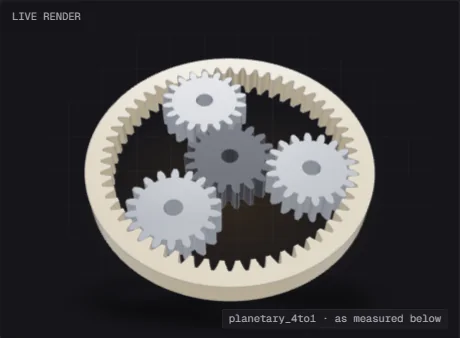
Type the part you need in plain English. CadKitty resolves every dimension to a real standard (module 1.5, 20° involute, ISO 53/54) instead of guessing.
Build from typed code.
Your request becomes a typed list of CAD operations. A deterministic compiler turns those into real geometry: same input, same output, never a guessed mesh.
Check before you download.
Every claim gets measured. The teeth are rotated against each other and checked for binding: a train that would jam never ships. Only then do you get the file.
Most tools guess. This one checks.
Ordinary text-to-3D lets a model invent geometry and hands you a mesh. CadKitty limits the model to picking known parts, builds the geometry from code, and proves it.
- Makes up critical dimensions
- Hands you a raw mesh to clean up
- Skips fit and printability
- Bluffs when the request is unclear
- No real standard behind the numbers
- It does not make up critical dimensions
- It pulls hardware sizes from real, cited standards
- It builds geometry from code, not a guessed mesh
- It checks fit and printability before export
- It says no when a request is unclear or impossible
Describe the part you need.
CadKitty will measure twice before it ships the file.